
Bottlenose Dolphin
Tursiops truncatus
Bottlenose Dolphin
Tursiops truncatus
Assessment Information
IUCN Status:
Vulnerable
Bottlenose dolphins are arguably the best known of all cetaceans; familiar to everyone thanks to the TV star "Flipper".

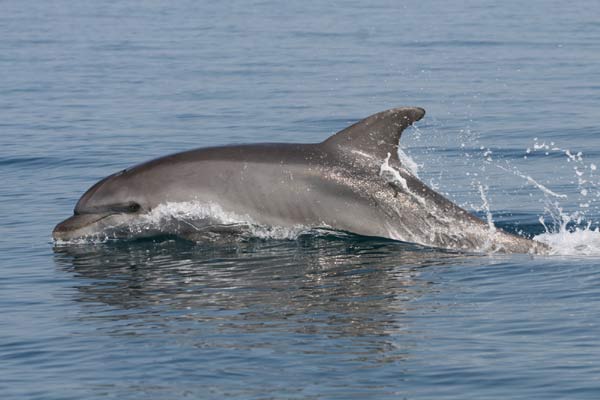
Bottlenose dolphin © M. Camm
Physical Description & Behaviour
The species has a robust appearance with a stocky snout distinctly set off from its forehead by a crease, which gives the animal its common name. It is usually slate grey or charcoal in colour, with a paler underbelly. Males can reach up to 3.8 m in length and 600 kg in weight. The dorsal fin is tall and curved.
They usually live in small groups in inshore habitats but may also be encountered offshore in groups of hundreds of individuals. Some bottlenose dolphins have been known to live solitary lives and to approach humans from time to time, such as “Fungie” in Western Ireland.
Bottlenose dolphins are very active swimmers. Tail slapping, leaping and aerial performances are often part of their natural behaviour. They prefer feeding on fish and molluscs, but their diet can be highly varied. They use echolocation for foraging like all toothed whale species.
Distribution & Abundance
Bottlenose dolphins are regarded as the most cosmopolitan of all dolphins. They are found in all temperate a nd tropical marine waters of the world. A few resident populations exist around the British Isles and used to be indigenous off the Dutch coast. A group of more than 100 individuals, which is permanently resident in the Moray Firth near Inverness and Cromarty in Scotland, is the northernmost bottlenose dolphin population worldwide. According to SCANS II about 2000 individuals inhabit the ASCOBANS area.
IUCN Red List of Threatened Species™ Assessment
- ASCOBANS Area: LC (least concern)
Threats
As an often coastal and very popular and intelligent species, bottlenose dolphins face a number of human-induced threats. These include direct catches and kills, live captures, bycatch in gillnets, driftnets, purse seines, trawls, long-lines, and on hook-and-line gear used in commercial and recreational fisheries, overfishing and the resulting prey depletion, marine pollution, underwater noise and tourism.
More information on the bottlenose dolphin can be found at
http://www.cms.int/reports/small_cetaceans/data/t_truncatus/t_truncatus.htm.
Threats
Threats
Diseases
Notes
Low
Threats
Bycatch
Notes
Low
Threats
Vessel Strikes
Notes
Low
Threats
Other
Notes
Bottlenose dolphin kill - Low
Threats
Prey depletion
Notes
Low
Geographic Range
Spain has both 'increase' and 'unkown' as its status. A more accurate description is 'uncertain' rather than a definite increase.