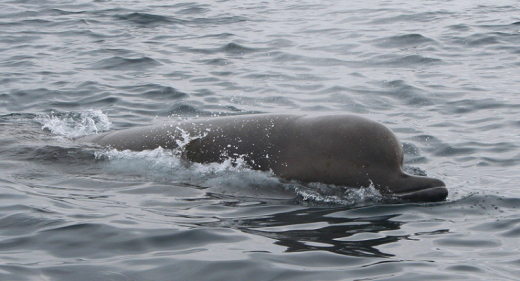
Cuvier’s beaked whale is difficult to observe and is the most common beaked whale in the Bay of Biscay. Even though it is globally distributed, little is still known about the species.
Physical description and behaviour:
The species reaches 5.1 m to 6.9 m length and becomes almost white on the back and head with age, although some diatoms can grow on the skin especially in tropical regions, giving it a dark orange or light brown colour. It usually has some light-coloured scars on the sides and back. Its head is small and has a slightly bulbous forehead. Similarly to other beaked whales, it has a single pair of teeth located on the top of the lower jaw. These are visible in males only as they stay under the gum in females and juveniles. Its flippers are narrow and small, have pointed tips and are placed low down the sides. The dorsal fin is rather small and triangular or hooked and is located two-thirds down the back.
The species can dive for long periods of time, with a research finding a median dive duration of 59 minutes across 3680 dives (Fahlman, 2020).
Distribution and abundance:
The species likely occurs worldwide in warm temperate to tropical seas. It is a regular inhabitant of waters around Canaries, Madeira, the Azores but also in the western North Atlantic in the Caribbean, Gulf of Mexico and south eastern United States. In the ASCOBANS Agreement Area is it mostly observed in the Bay of Biscay and the Iberian Peninsula. However the number of sightings have increased further north and east in Iceland, Sweden and the Netherlands. The first stranding in Denmark has also now been recorded (Alstrup et al., 2021).
There is currently no abundance estimate for the species. However the SCANS-III Project estimated around 11,394 individuals of beaked whales species to live in the surveyed area (including northern bottlenose whale and all Mesoplodon species). The ObSERVE surveys also estimated the abundance of Cuvier’s beaked whales to be of 237 in summer 2016 and 765 in winter 2016-2017 (Rogan et al., 2018).
IUCN Red List of Threatened Species™ Assessment
- LC (Least Concern) globally, last assessed in 2018
- DD (Data Deficient) in European waters, last assessed in 2007
Threats:
Cuvier’s beaked whales are known to be especially sensitive to the effects of mid-frequency active sonars, which have likely resulted in mass strandings in the past.
Threats
Threats
Prey depletion
Notes
Low
Threats
Noise pollution
Notes
Low
(Gas embolism)
Geographic Range
United Kingdom has both 'increase' and 'unknown' as its statuA more accurate description is 'uncertain' rather than a definite increase.