
Long-Finned Pilot Whale
Globicephala melas
Long-Finned Pilot Whale
Globicephala melas
Assessment Information
IUCN Status:
Data deficient
The long-finned pilot whale is one of two species of the genus Globicephala, which is closely related to the killer whale, although its behaviour is more similar to that of large baleen whales.

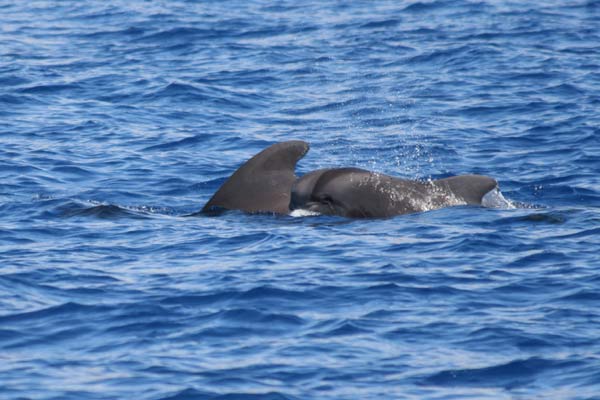
Long-finned pilot whale © M. Camm
Physical Description & Behaviour
Pilot whales are highly social and among the most gregarious of all cetaceans, forming schools or pods averaging 20-90 individuals. Their social structure is similar to that of killer whales, and involves close matriarchal associations.
Male and female pilot whales differ in size, similar to sperm and killer whales. Adult males are longer than females and have a much longer dorsal fin. Long-finned pilot whales are characterised by their dark brownish grey to black colour and extraordinarily long flippers. Adult males develop a bulbous forehead and reach 6.7 m in length and a weight of 2 tons. The only definitive characteristic that distinguishes the long-finned from the short-finned pilot whale (G. macrorhynchus) is its narrower skull. Size, shape and colour patterns are highly variable in both species.
In general, pilot whales are nomadic but a few resident populations have been documented, e.g. on the California coast and in Hawaii. Their diet consists primarily of squid and a lesser amount of fish. Their fish prey in the North Atlantic includes cod, turbot, herring, hake and mackerel.
Distribution & Abundance
Long-finned pilot whales are usually distributed in non-tropical waters, in contrast to the short-finned species. There is little overlap in the species. They can be found inshore and also in open ocean environments.
Abundance estimates have been undertaken for Newfoundland/Labrador in 1982 (6,700 - 19,600 individuals) and the North-east Atlantic in 1989 (publication from 1993) (778 000 individuals). According to the SCANS II Project, long-finned pilot whales in the ASCOBANS area are restricted to the very south of the British Islands and the coast of Norway, and are present in low numbers only.
IUCN Red List of Threatened Species™ Assessment
- DD (Data Deficient) in European waters, assessed in 2007
- LC (Least Concern) globally, assessed in 2018
Threats
Because of their cohesive social structure, pilot whales are susceptible to herding by humans. Historically there have been a number of target fisheries in the North Atlantic, Newfoundland, Cape Cod, Norway, Iceland, the Orkneys Islands, Greenland and the Faeroe Islands. Drive hunts in the Faeroes (outside of the area of application of ASCOBANS) are still ongoing, with an average annual catch of 850 animals in the period. The Newfoundland fishery alone is estimated to have taken more than 54,000 pilot whales between 1947 and 1971. The populations seem to have recovered from this extensive whaling but more information is needed.
Pilot whales are particularly susceptible to entanglement in driftnets, when targeting swordfish and sharks, but the effect on their populations is unknown. Other fisheries, such as trawls and long-lines, also incidentally kill pilot whales.
Pilot whales are one of the most frequently reported cetaceans to be involved in mass strandings. Usually, these strandings involve the entire group of animals. There is considerable evidence that when one member of the group is in trouble, the others attempt to help. Sometimes the mass strandings are the result of viral infections. Marine pollution, underwater noise and habitat loss is of additional concern.
More information on the long-finned pilot whale can be found at
http://www.cms.int/reports/small_cetaceans/data/G_melas/g_melas.htm.
Gallery
Threats
Threats
Diseases
Notes
Low
Threats
Bycatch
Notes
Low
Threats
Vessel Strikes
Notes
Low
Threats
Prey depletion
Notes
Low