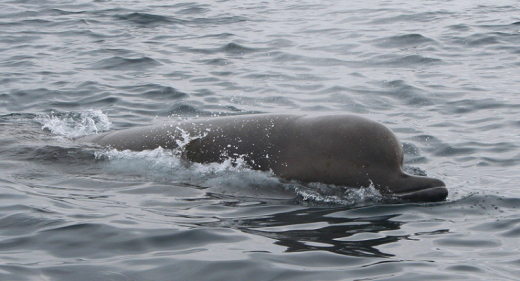
Sowerby’s beaked whale inhabits deep waters and is the species the most often recorded of the genus Mesoplodon even if it is rarely seen alive. It seems to inhabit a range somewhat north of the other species in its genus.
Physical description and behaviour:
Sowerby’s beaked whales have a slender tapering body, rather small and narrow flippers and a slender and small recurved dorsal fin located almost two-third along their back. Their body tends to be dark grey in colour and relatively long, as females measure around 5.1 m length and males 5.5 m. Males have a single pair of teeth extruding from the middle of their beak. The species’ head is small and like other beaked whales, they have a well-defined and long beak. They also tend to have a noticeable bulge in front of their blowhole.
Sowerby’s beaked whale is fairly uncommon and typically forms small groups rarely exceeding 10 individuals. It prefers deep water habitats of 700 m depth or more and is very rarely observed alive. They tend to come to the surface only briefly. The species’ diet seems to mainly consist of fish and occasionally cephalopods (Pereira et al., 2011). They are believed to feed on the most abundant mid-water species between 0 and 750 m depth.
Distribution and abundance:
The species is found more often on the North East Atlantic than on the East coast of the United States. Sightings have been confirmed in the Norwegian Sea, south of Iceland, west of Norway, north and west of the British Isles and Ireland, around the Faroe Islands, in the Channel Approaches and in the Bay of Biscay (Evans et al., 2008; McLeod, 2000, 2005). It has also been observed closer to the Azores and Madeira.
Acoustic work conducted west of Ireland detected a wide distribution but with the highest occurrences in May off northwest Ireland (Kowarski et al., 2018). There is however no population estimate.
IUCN Red List of Threatened Species™ Assessment
- LC (Least Concern) globally, last assessed in 2020
- DD (Data Deficient) in European waters, last assessed in 2007
Threats:
Threats to the species are currently unknown, although they are likely similar to other beaked whales’, that is mostly related to underwater noise disturbances such as mid-frequency active sonar. Other threats could include entanglements in fishing gear such as driftnets and alterations of their habitats due to global climate change (Learmonth et al., 2006; Waring et al., 2001).
Threats
Threats
Vessel Strikes
Notes
Low
Threats
Noise pollution
Notes
Low
(Gas embolism)