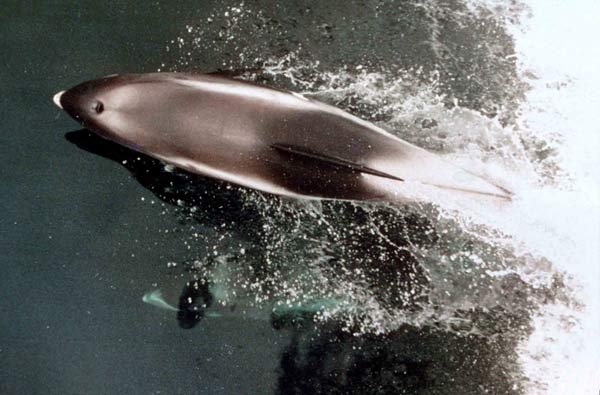
The white-beaked dolphin was only recognized as a separate species in 1846. Earlier finds remain unclear because they were sometimes confused with bottlenose (Tursiops truncatus) or common dolphins (Delphinus spp.).
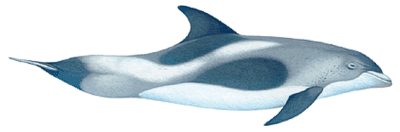
White-beaked Dolphin © M. Camm
Physical Description & Behaviour
White-beaked dolphins are large and robust animals with a short thick snout (their beak is not more than 5-8 cm long) and a tall curved dorsal fin. Adults grow between 2.4 and 3.1 m long and weigh up to 350 kg. Their colouration is typically black on the back with a light saddle behind the dorsal fin and white bands on the flanks.
Schools of 20 animals are common but much larger schools have sometimes been recorded. They frequently ride on the bow-waves of vessels.
White-beaked dolphins feed on mid-water fish, especially cod, whiting, and other gadids, and squids. From time to time they have been observed feeding with orcas, fin or humpback whales.
Distribution & Abundance
The species is endemic in the sub-arctic North Atlantic, inhabiting shelf and sometimes shallow coastal waters.
The white-beaked dolphin is abundant in the northern North Sea and not uncommon in the southern part along the coast of the United Kingdom, Denmark, Belgium, the Netherlands and Germany. In some years small schools enter the Baltic Sea as well. According to the SCANS II Project, more than 8,000 individuals inhabit the ASCOBANS area. That abundance estimate could be somewhat inaccurate, however, as aerial surveys often do not allow white-beaked dolphins to be distinguished from white-sided dolphins.
IUCN Red List of Threatened Species™ Assessment
Threats
Although not a target of any large commercial fisheries, there has been a long history of small-scale hunting in some countries, such as Norway, the Faeroe Islands, Greenland and Iceland. Incidental bycatch – mainly young individuals – occurs in trawl and bottom gill nets. As with many other marine mammals, ocean pollution and underwater noise pollution is of increasing concern. White-beaked dolphins are regionally contaminated by chlorine-derived pollutants and heavy metals, which negatively affect their health status.
More information on the white-beaked dolphin can be found at
http://www.cms.int/reports/small_cetaceans/data/l_albirostris/l_albirostris.htm.